Alert and Warning Systems
in Boulder County, from the Office of Disaster Management
Boulder County Alert and Warning Systems
Preparing for communication during a disaster - related to both sending and receiving information - is a critical part of personal preparedness. In Boulder County we have a variety of alert types, however it's important to remember that trusting your gut should always your first alerting mechanism. If you see, hear, smell, or sense something that seems dangerous, take actions to keep yourself safe immediately, then call 911 to report it.
How Alerts Get to You
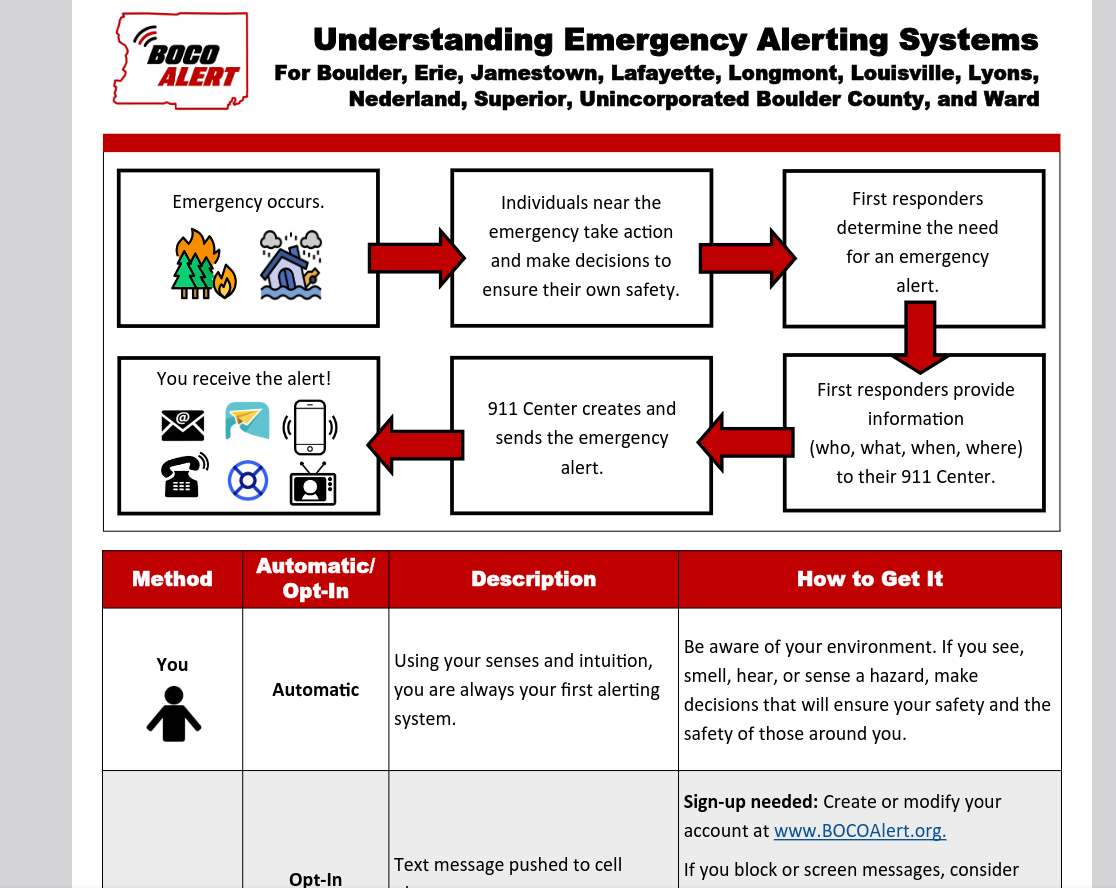
When incidents occur, first responders arrive on scene and determine what areas need to be alerted. Once they've evaluated the scene, they communicate back to 911 dispatchers who then write up and send alert information in a variety of formats as shown below:
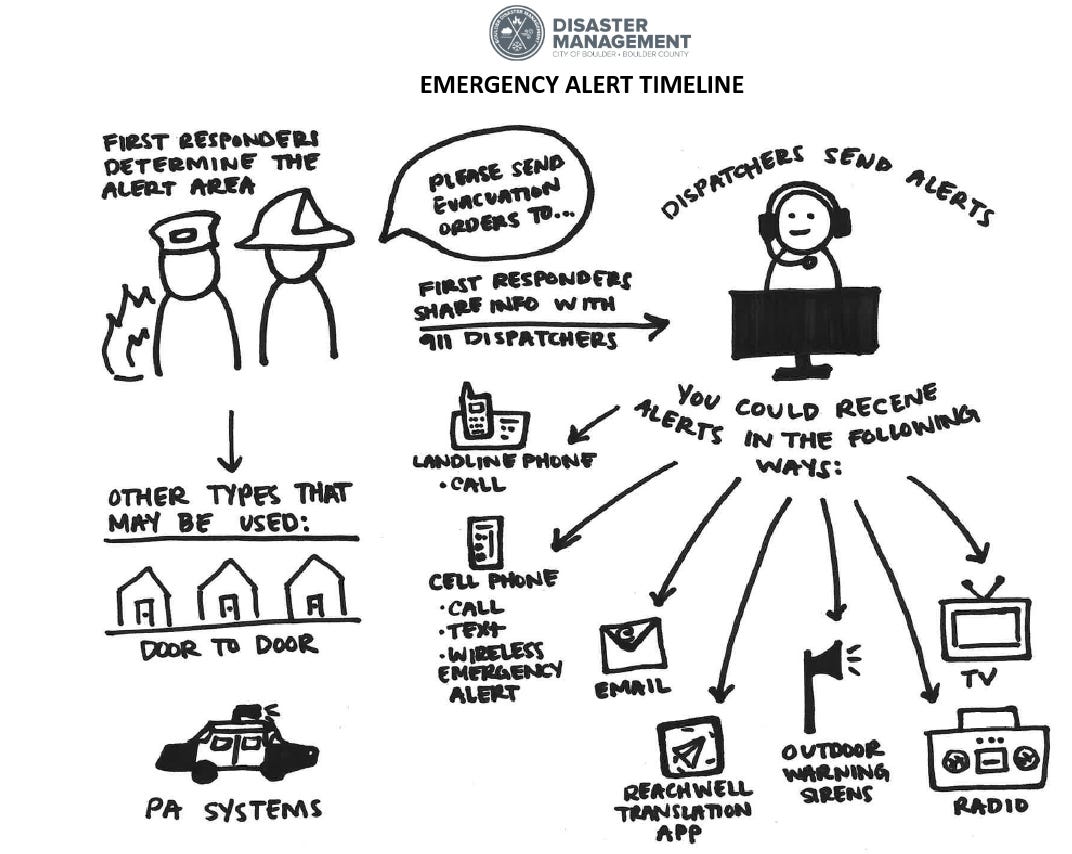
The following describe the formal alerting types that we have in Boulder County:
Opt-In Alerts
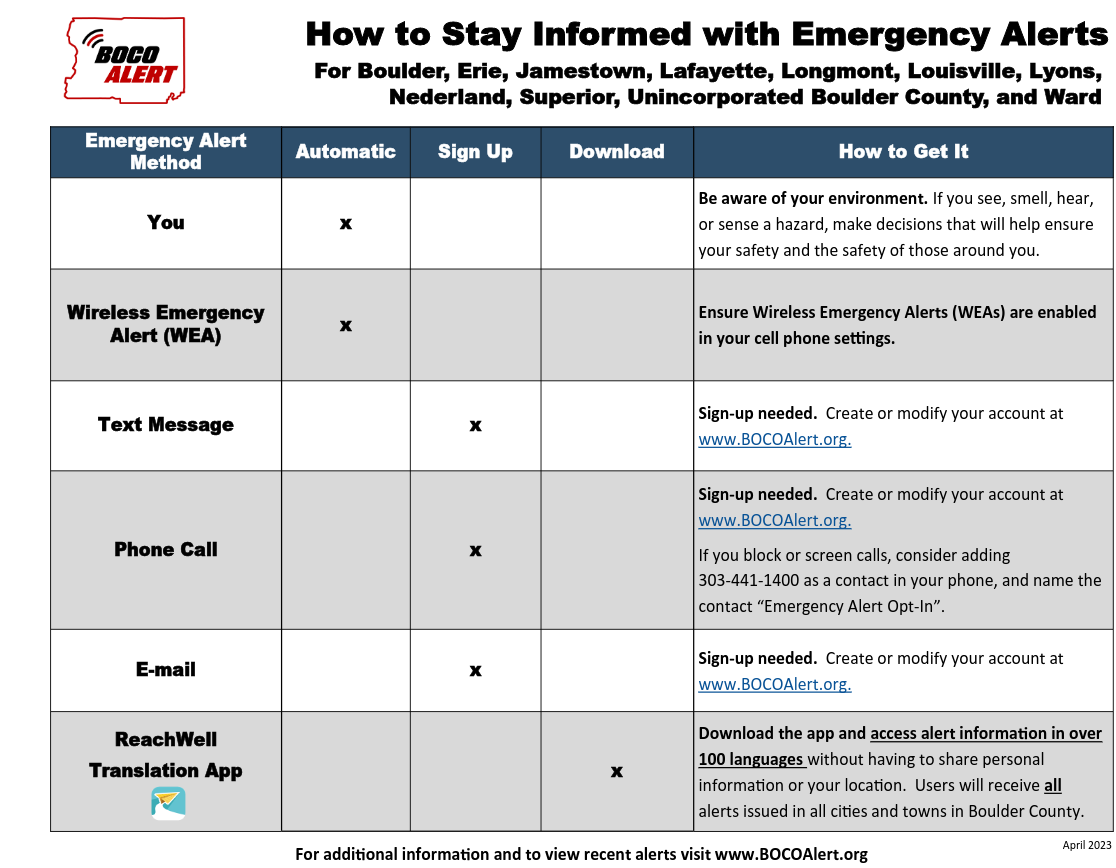
Opt-In Alerts are those that community members need to register or "opt-in" for, and provide critical information related to emergency or disaster situations. You can register for Opt-In Alerts at
https://bocoalert.org
- once you create an account you can then add multiple phone numbers and e-mails to receive alerts through, and can (and should) add multiple addresses.
Adding multiple addresses is a critical part of your account set-up, as you will only receive alerts if an address tied to your account is within the area that first responders determine needs to be alerted . You can add up to 5 addresses per account, so we encourage community members to add not only their home, but workplace, schools, or other regularly frequented areas!
ReachWell Translation App
If you found yourself thinking that 5 addresses would not be enough to cover all the areas that you may be in, then the ReachWell App will serve as a great support. The ReachWell App allows users to get emergency alerts (the same alerts that are sent through the opt-in system) in over 100 languages, and without having to sign-up or share personal information. Once a user downloads the ReachWell App and searches for BOCO Alert they can allow notifications and will start receiving emergency alert information through a notification in the app.
Users will receive all alerts that go out in the county, so will need to be able to determine if the alert is relevant to their location. With that said, while it may sound overwhelming we typically only receive 1 alert every other week, if that.
Wireless Emergency Alerts (WEA)
Wireless Emergency Alerts are part of the Federal IPAWS (Integrated Public Alerting System) and are denoted by an "Amber Alert" style tone when they are sent through in a text-based format. No registration is needed - instead, these alerts are geographically based, meaning if you (and your phone) are in the alerting area you will receive the alert if you're within cell range.
Outdoor Warning Sirens
Outdoor warning sirens, as their name implies, are meant to provide alert information for individuals who are outdoors. Sirens are typically used for flash flooding and wildfire scenarios in the mountainous and canyon regions of Boulder County, however what they're used for varies from area to area around the county.
Emergency Alert System (EAS)
The Emergency Alert System, or EAS, is comprised of alerts that go out through radio or television. If you've ever heard three beeps and a robot-sounding voice sound through your radio, or a message come up on your tv screen regarding severe weather or other disaster-type of situations you've received an alert through the EAS. These types of alerts are typically used for severe weather scenarios, like flash flooding or severe thunderstorms.
Informal Alerting Systems
While we have many formal types of emergency alerts, the importance of informal alerting cannot be underscored enough. Anytime an incident occurs where an alert eventually is sent, a member (or multiple members) of our community saw it first and called it in to 911. With this in mind, lean into current support systems with neighbors and friends to help notify one another, and continue to build on these important relationships. We know that neighbors helping neighbors is a strong way that community members support one another when they are in immediate proximity to an evolving emergency situation, and the care that you put into those relationships help us maintain a more resilient community.
Remember - always trust your gut - if you see, hear, smell, or sense a dangerous situation, take actions to keep yourself safe. For more information on emergency alerts, visit www.boulderodm.gov.
For a comprehensive list of alert types, what they are, and how to receive them visit Boulder Office of Disaster Management's Resource Library and click any of the links listed under "Emergency Alert Resources" - there are resources available in English and Spanish.
To sign-up for alerts visit
https://bocoalert.org
.
To get more information on the ReachWell App, including directions on how to access it, visit Boulder Office of Disaster Management's ReachWell App Page.
For more information on disaster preparedness, visit Boulder Office of Disaster Management's Preparedness Page.